Not sure what you have? Describe it and we will tell you.
Rodents and wildlife
Termites and timber
Stinging insects
Crawling and flying
Property programs

Termite Control Melbourne | Termite Exterminator
Mud tubes or hollow timber? Our termite control Melbourne team finds the colony and treats it with baiting or barriers. Call 0401 573 777 for a free quote.
How do you get rid of termites in Melbourne?
Reviewed by the Metro Pest Services team, updated September 2026
You get rid of termites by finding where they are coming from and killing the colony, not by spraying the ones you can see. In Victoria, Coptotermes termites cause more than 80 per cent of termite damage to buildings, and a single colony can hold around 500,000 termites that forage at least 50 metres from the nest.
That is why every job starts with an inspection. Once we know the species, where they are feeding and how they are getting in, the answer is usually a termite baiting system to eliminate the colony, a chemical soil barrier to keep the next one out, or both.
People search for termite removal Melbourne wide, but termites cannot be lifted out like a wasp nest. The colony has to be killed where it lives, and that is the job a good termite exterminator actually does.
Species and colony figures come from the Victorian Department of Health guidance on termites.
| Termite inspection cost Melbourne | from $200 |
|---|---|
| Colony baiting system | from $1,400 |
| Termite barrier Melbourne (chemical soil) | from $1,500 |
| Main culprit in Victoria | Coptotermes, over 80% of building damage |
| Typical colony size | About 500,000 termites, up to 1 million |
| Foraging range | At least 50 metres from the nest |
| Home insurance | Termite damage is usually excluded |
| Recommended check | An inspection at least once a year |
Signs of termites in a Melbourne home
Termites eat timber from the inside and stay out of the light, so the damage is usually well advanced before anyone sees a termite. These are the signs our inspections pick up most often.
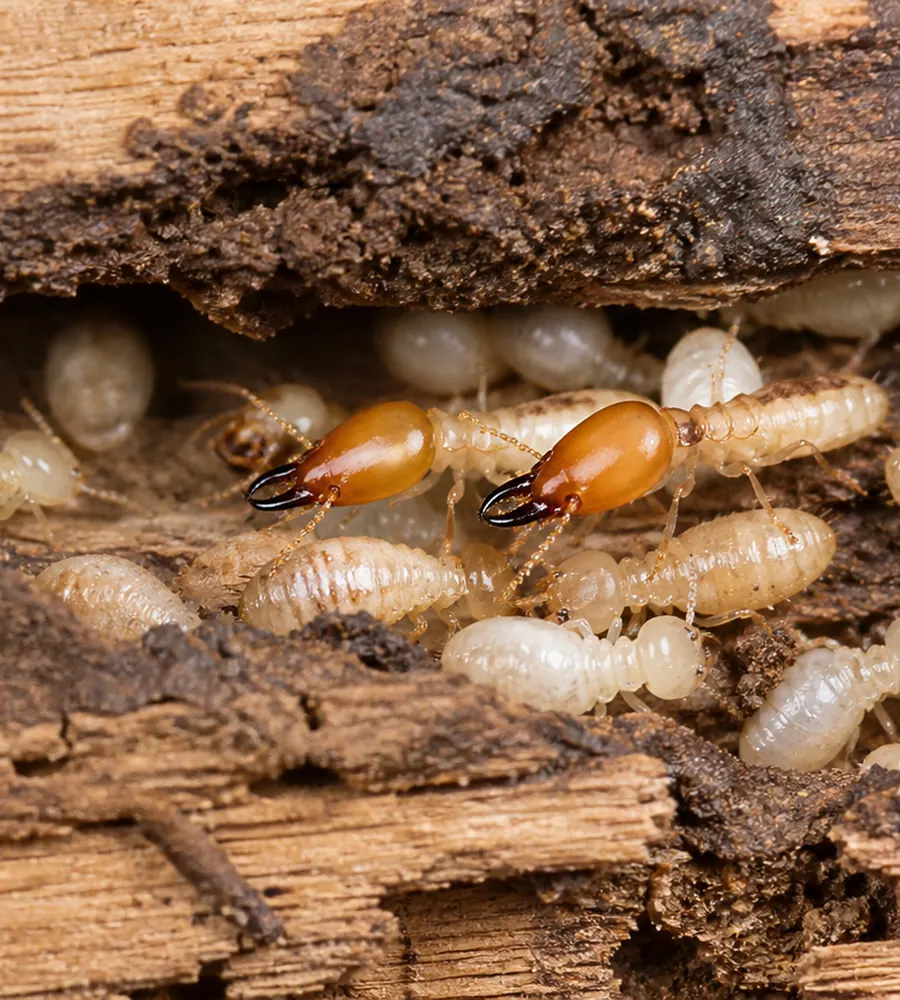
Mud tubes on walls or piers
Pencil width tunnels of soil running up brickwork, stumps or the inside of a garage. Termites build them so they can travel without drying out.
Timber that sounds hollow
Skirting boards, architraves or door frames that sound papery when tapped, or give way under a thumb, can be a thin shell over eaten timber.
Bubbling or rippled paint
Paint that blisters in a line can mean termites have eaten the timber right up to the painted surface.
Doors and windows that start to stick
Moisture from an active nest can swell frames, so a door that suddenly binds is worth a closer look.
Discarded wings on sills
Small piles of equal sized wings near windows or lights, often after warm humid evenings, point to a colony nearby.
Soil packed into cracks
Mud pressed into gaps in timber, cornices or around power points is a sign of workers sealing a feeding site.
Which termites attack homes in Victoria
Victoria has five groups of termites that damage buildings. Which one you have changes the treatment, so we identify the soldiers before we recommend anything.
Coptotermes
Coptotermes acinaciformis and Coptotermes frenchi- Where
- Across Victoria, including every part of Melbourne. Nests in eucalypts, stumps, under concrete slabs and inside wall cavities.
- Damage
- More than 80 per cent of termite damage to buildings in Victoria. Colonies of around 500,000 that travel at least 50 metres to feed.
- Treatment
- C. acinaciformis responds strongly to baiting. C. frenchi responds less strongly, which can mean a soil barrier or direct treatment instead.
Dampwood termite
Porotermes adamsoni- Where
- Wet mountain areas, and also the drier foothills around Melbourne.
- Damage
- Victoria's largest termite, living in damp or decaying timber. Smaller colonies that do not build shelter tubes.
- Treatment
- More easily controlled than other species, usually by removing the damp timber and fixing the moisture problem.
Mound building termite
Nasutitermes exitiosus- Where
- Mostly north of the Great Dividing Range, in mounds that can reach a metre across.
- Damage
- Less of a problem for Victorian houses. Most often attacks garden timbers, sleepers and fence posts.
- Treatment
- Treated at the mound or in the timber it is attacking.
Schedorhinotermes
Schedorhinotermes species- Where
- Northern Victoria rather than Melbourne.
- Damage
- Destructive and relatively nomadic, with two sizes of soldier.
- Treatment
- Needs identifying first, because its colonies move and it does not behave like Coptotermes.
Heterotermes
Heterotermes ferox- Where
- Found in Victoria but not a major pest here.
- Damage
- Fence posts, paling fences and timber flooring, within a small radius.
- Treatment
- Usually a localised treatment of the affected timber.
Termites are not white ants
Plenty of people in Melbourne still call them white ants, but termites are more closely related to cockroaches than to ants. Supermarket ant sprays and ant baits do nothing to a termite colony.
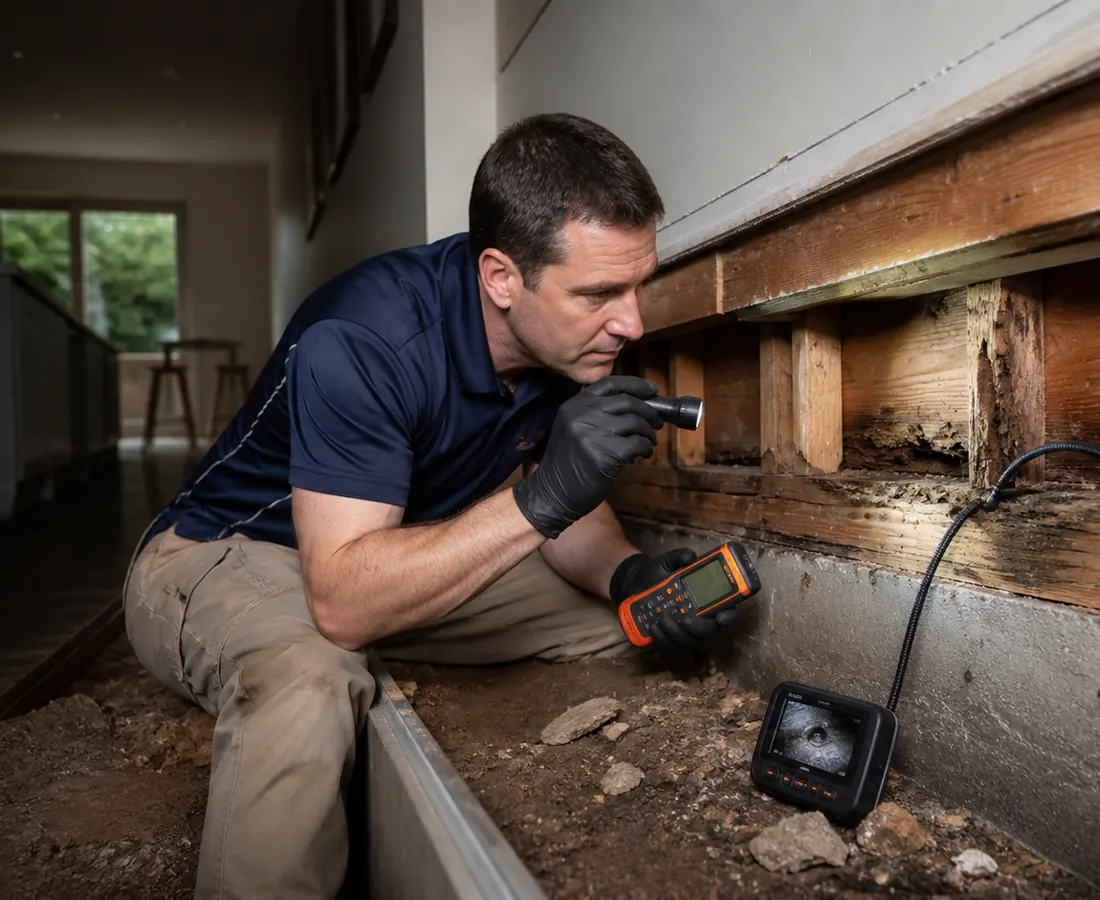
Termite inspection Melbourne: what we actually check
A proper termite inspection is a slow walk through every part of the property where termites feed or travel, not a torch shone into the kitchen cupboard. For a standard house it usually takes one to two hours.
- Roof void, subfloor and every accessible room
- Thermal imaging and moisture readings on walls and timber
- Fences, decks, pergolas, sleepers and garden edges
- Trees and stumps within about 50 metres of the house
- Weep holes, slab edges and anywhere soil meets timber
- A written report of what we found and what we recommend
Buying a house? We also carry out a pre-purchase termite inspection, with a written report you can take to your conveyancer before you sign. Once a home is clear, we recommend an inspection at least once a year.
Termite treatment Melbourne: baiting system or chemical barrier?
They do different jobs. Baiting kills the colony that is attacking you, and a barrier stops termites getting into the building. Most active infestations need the first, and many homes are better off with both.
Colony baiting system
from$1,400
Best whenTermites are active and the nest cannot be found, which is most of the time with Coptotermes.
How it worksBait stations go onto active workings and around the house. Workers carry a slow acting growth regulator back to the nest, and the colony dies over the following weeks to months.
Keep in mindBaiting removes a colony. On its own it does not stop a new one arriving, so we keep monitoring or add a barrier.
Chemical soil barrier
from$1,500
Best whenThe colony has been dealt with, or you want protection for a house with no current activity.
How it worksA non-repellent termiticide goes into a trench and under paths around the whole perimeter. Termites pass through without noticing and carry it back to the colony.
Keep in mindIt needs access to the soil all the way around the house. Concrete paths are drilled and injected, and that is what moves the price.
Direct nest and timber treatment
Quoted on inspection
Best whenWe can reach the nest or the active workings, for example in a tree, a stump or a wall cavity.
How it worksTermiticide foam or growth regulator dust goes straight into the nest or galleries, using the least product that will do the job.
Keep in mindIt is quick, but it only treats what we can reach, so we come back to confirm the activity has stopped.
Our usual approach for an active infestation: bait first to eliminate the colony, then install a soil barrier so the house stays protected. We will tell you honestly when one of the two is enough.
Do not spray them. Here is what to do instead.
The natural reaction is to grab a can of fly spray or knock the mud tubes off the wall. It feels like doing something, but it is the quickest way to make a termite problem harder to fix.
- 1Leave the mud tubes and damaged timber exactly as they are. Disturbed termites often abandon that spot and turn up somewhere harder to reach.
- 2Do not spray them. A surface spray kills the few termites you can see and pushes the rest away from where a bait would have worked.
- 3Take a photo, note where you saw them, and keep children and pets away from any timber that looks weak.
- 4Book an inspection. The sooner we see live termites in place, the more treatment options you have.
From inspection to protected, in four steps
What happens after you book a termite inspection with us.
Book the inspection
Call or send the form. We confirm the inspection price and a time that suits you, 7 days a week.
Inspect and identify
We inspect the whole property, confirm whether termites are active and identify the species.
Recommend and quote
You get a written report with the options that suit your home and a fixed price for each one.
Treat and protect
We install the system you choose, monitor baiting until the colony is gone and put your warranty in writing.
Termite treatment cost Melbourne: what you will pay
Termite prices depend on the size of the house, how much of the perimeter is concrete and how established the activity is. These are our starting prices, and you get a fixed written price after the inspection.
Melbourne termite inspection
from$200
- Whole property inspected
- Thermal imaging and moisture readings
- Written findings report
Colony baiting system
from$1,400
- Bait stations installed on activity
- Regular monitoring visits
- Colony elimination confirmed
Chemical soil barrier
from$1,500
- Perimeter trench and treat
- Paths drilled and injected where needed
- Warranty certificate
Also quoted on inspection
- Direct nest treatment in trees, stumps and wall cavities
- Pre-purchase termite inspection priced by property size
- Annual termite inspection once your home is clear
No call-out fee in metropolitan Melbourne. For comparison, 2026 Melbourne price guides put a termite inspection anywhere from about $250 to $450, and a full chemical barrier from about $3,000 to $5,000.
- Covers
- Baiting systems and soil barriers
- Warranty length
- Stated on your certificate
- If termites return
- Free re-treatment
- To keep it valid
- Annual termite inspection
Metro Pest Services · Melbourne
Termite protection Melbourne homes can hold us to, in writing
Every baiting system or soil barrier we install comes with a warranty certificate. The length depends on the system and the product, and it is written on the certificate before you pay.
Like almost every termite warranty in Australia, it asks one thing of you: an inspection each year, so a new colony is caught early instead of being found by accident.
- Warranty length stated on your certificate
- Free re-treatment if termites return inside the warranty period
- Annual inspection reminders so the warranty stays valid
Three things most termite companies will not tell you
A very cheap inspection is usually a sales visit
A thorough inspection takes an experienced technician one to two hours on site, plus the report. When the price is far below that, the inspection is often just a way through the door to sell a treatment.
Brick and steel framed homes still get termites
Termites do not care what the walls are made of. They travel through gaps in slabs and brickwork to reach roof timbers, skirting boards, door frames and kitchen cabinets.
Home insurance usually will not pay for the damage
Most Australian home insurance policies exclude termite damage. An annual inspection costs far less than replacing a section of wall frame, and it is the protection you actually control.
How to keep termites away from your house
Termites need timber and moisture. Taking away easy access to both makes a real difference, and none of it costs much.
Keep soil and garden beds below the weep holes and away from any timber.
Fix leaking taps, downpipes and air conditioner drains close to the house.
Keep the subfloor ventilated and dry, with vents clear of plants.
Store firewood, sleepers and offcuts off the ground and away from walls.
Book a termite inspection every year, even when you have seen nothing.
Termite inspections across all of Melbourne
Termites are active in every part of Melbourne, from older inner suburbs with timber subfloors to new estates on the city fringe. We inspect and treat anywhere in the metropolitan area, with no call-out fee.
Inner Melbourne
- Melbourne CBD
- Carlton
- Fitzroy
- Richmond
- South Yarra
- St Kilda
- Collingwood
- Docklands
Northern suburbs
- Brunswick
- Coburg
- Preston
- Reservoir
- Epping
- Craigieburn
- Bundoora
- Heidelberg
Eastern suburbs
- Box Hill
- Doncaster
- Ringwood
- Glen Waverley
- Blackburn
- Croydon
- Boronia
- Lilydale
South east
- Dandenong
- Clayton
- Cranbourne
- Narre Warren
- Berwick
- Pakenham
- Springvale
- Keysborough
Bayside and south
- Brighton
- Sandringham
- Cheltenham
- Mentone
- Mordialloc
- Frankston
- Seaford
- Carrum Downs
Western suburbs
- Footscray
- Sunshine
- Altona
- Point Cook
- Werribee
- Hoppers Crossing
- Tarneit
- Melton
Termite control Narre Warren. Newer estates with slab homes and landscaping timber against brickwork, so slab edges and weep holes get a close look.
Termite control Frankston. Homes close to bushland reserves, where colonies nesting in stumps and old trees can reach fences and decks first.
Termite inspection Greensborough. Big established gardens and eucalypts along the Plenty River. Most termite control Greensborough jobs start in the garden, and termite treatment Greensborough homes need is usually baiting.
Termite inspection Mornington Peninsula. Holiday homes, timber decks and coastal bush. Termite control Mornington Peninsula properties need often includes decks and sheds, and termite treatment Mornington Peninsula wide is quoted after inspection.
Termite inspection Werribee. A mix of newer estates and older homes near the Werribee River, where garden sleepers and fence lines are worth checking.
Termite control Glen Waverley. Established brick veneer homes with mature gardens, where termites often reach the house through the subfloor or a timber pergola.
Termite Control Melbourne FAQs
Not sure whether what you found is termites? Call us and describe it. We will tell you on the phone whether it needs an inspection.
Call 0401 573 777How much does termite treatment cost in Melbourne?
With us a termite inspection starts from $200, a colony baiting system from $1,400 and a chemical soil barrier from $1,500. The final price depends on the size of the house, how much concrete has to be drilled and how established the termites are, and you get a fixed written price after the inspection.
How much does a termite inspection cost?
Our termite inspections start from $200 for a standard house, including thermal imaging, moisture readings and a written findings report. Larger properties and pre-purchase inspections are priced by size before we book.
What are the signs of termites?
Mud tubes on walls or piers, timber that sounds hollow when tapped, bubbling paint, doors that start to stick, piles of discarded wings near windows and soil packed into cracks. Most homeowners see the damage before they ever see a termite.
Is a termite baiting system or a chemical barrier better?
They do different jobs. A baiting system kills the colony that is attacking the house, while a chemical soil barrier stops termites getting in. For an active infestation we usually bait first and then install a barrier.
How long does a termite barrier last?
It depends on the product and the soil. Most modern soil treatments are labelled to protect for several years, and the exact period for your home is written on your warranty certificate, together with the annual inspection it requires.
How long does termite baiting take to work?
Once termites are feeding on the bait, a colony usually dies within weeks to a few months. We keep checking the stations until there is no more activity, then confirm the result in writing.
Does home insurance cover termite damage?
Usually not. Most Australian home insurance policies exclude termite damage, which is why an annual termite inspection is the cheapest protection a Melbourne homeowner can buy.
Should I spray termites if I find them?
No. Spraying or breaking open mud tubes makes termites leave that spot, which makes the colony harder to find and bait. Leave everything as it is, take a photo and book an inspection.
Are termites the same as white ants?
Yes, white ants is the old name for termites, but they are not ants at all. Termites are closely related to cockroaches, which is why ant sprays and ant baits do not affect them.
Are termites Melbourne wide, or only in some suburbs?
Termites are found right across Melbourne. Suburbs near bushland, big old trees or creeks tend to see more activity, but new estates are not immune, which is why every home benefits from a regular inspection.
How often should I get a termite inspection?
At least once a year for most Melbourne homes. Properties with a history of termites, lots of garden timber, big old trees or a damp subfloor can benefit from a check every six months.
Do you do pre-purchase termite inspections?
Yes. We inspect the property before you buy and give you a written report on any termite activity, damage or risk, so you and your conveyancer know what you are taking on.
Can children and pets be around termite treatment?
Treatments go into soil, bait stations, nests and wall cavities rather than being sprayed around living areas. We tell you which areas to keep children and pets away from and for how long, and write it on your report.
Worried about termites? Get it checked properly.
A termite inspection from $200, a written report, and a straight answer on whether you need treatment at all.